A marathon is a 42.2km endeavour. It’s a phenomenal feat to complete, but you can imagine the physical and mental preparation to safely complete the run. It often requires a team to support the journey, whether physically, mentally or emotionally. Training begins months in advance. This is no different than pregnancy, a 40-week journey for the birthing person and their support team.

Even before deciding to have a baby, it would be a good idea to gauge your physical, mental, emotional, and financial health. Growing a baby changes everything!
We need to acknowledge:
- What the current baseline fitness / exercise level is
- Sleep productivity
- The health of the diet
- What family members are impacted / involved
- Health of relationship with family
- What kind of supports there are from others
- Mental health
- Financial / job security
- Current life stressors
- Potential changes in roles within the relationship
Understand that throughout pregnancy, checking in on all aspects above are critical to set you up for the big event – the birth!

It is important to exercise throughout pregnancy. It is safe in every trimester, as long as there are no complications that the doctor or midwife has informed you of. The goal is to maintain what you can of your baseline fitness and exercise regimen, if you were very active already, or to start exercising and work your way up to 150 minutes of moderate to vigorous intensity exercise if you have a sedentary lifestyle. Additionally, the birth person will want to work on preparing the pelvic floor muscles for the increased demands that pregnancy and birth impose, and to maintain core strength as the abdomen distends with the baby’s growth. Postural exercises are also helpful to counter the body changes seen in pregnancy.

A well-balanced diet is important for the birth person’s and baby’s growth. Prenatal vitamins are a necessity for health baby development. Although pregnancy-related symptoms such as nausea, food aversions and food cravings may be challenging to navigate, keep a log of what you’re putting into your body.
Pregnancy can be a stressful time. Carve out time to de-stress:
- try mindfulness activities
- rest and relax
- reconnecting with your partner, friends and family
- go out in nature
- SLEEP! Nap! Once the baby comes, this is severely impacted, so enjoy it while you can
It is also important to check in on everyone’s mental health. Have open conversations about what you need of each other. If there are other kids involved, what are their needs, and how they feel about adding to the family? Prepare them for missing parents for a while. Perhaps have them sleep over with the caregiver’s place for a night or two so they adjust to the change before the birth.

As the third trimester approaches, it is time to prepare to push. Both the birth person and birth partner can learn about pain management strategies, create a birth plan and share it with the healthcare team. A pelvic floor physiotherapist can also review perineal massage to physically prepare the area for birth, as well as go over some positioning and pushing strategies.
Education on what to expect in the 4th trimester, along with behaviours to look out for when a sibling arrives, can be helpful. Consider classes on infant CPR, sleep for the baby, food for baby, and babyproofing (though you can do after birth, but if have time and energy now, it may be a good idea). Make sure your hospital bag is packed and ready to go, if you plan to deliver in a hospital.
Setting yourself up for after birth take some stress off everyone. In the case of keeping a baby, consider how involved friends and family may be after, and would it be helpful to hire more help Set up essentials for taking the baby home (e.g., where they will sleep, get the sleep sack and a few clothes ready, install the car seat, have a stroller). Having some food prepared and frozen can save a lot of time and energy as well. In the case of not keeping the baby, have a plan of how to stop lactation, any services you may require to cope with the decision, communicate with friends and family what you need from them (including what to say or not say, setting boundaries), and have ideas of what to do to de-stress and gradually return to activities. Food preparation can also be helpful in this case, to unload some of the physical and mental tasks.

Race day is the birth of the baby! All that preparation leads up to this event. Just like a race, it may go as planned, or it may not. It is important to do the best you can on that day and accept it for what it is. Be grateful to yourself and your team for engaging in the full journey. However the event goes, it is an accomplishment of itself.
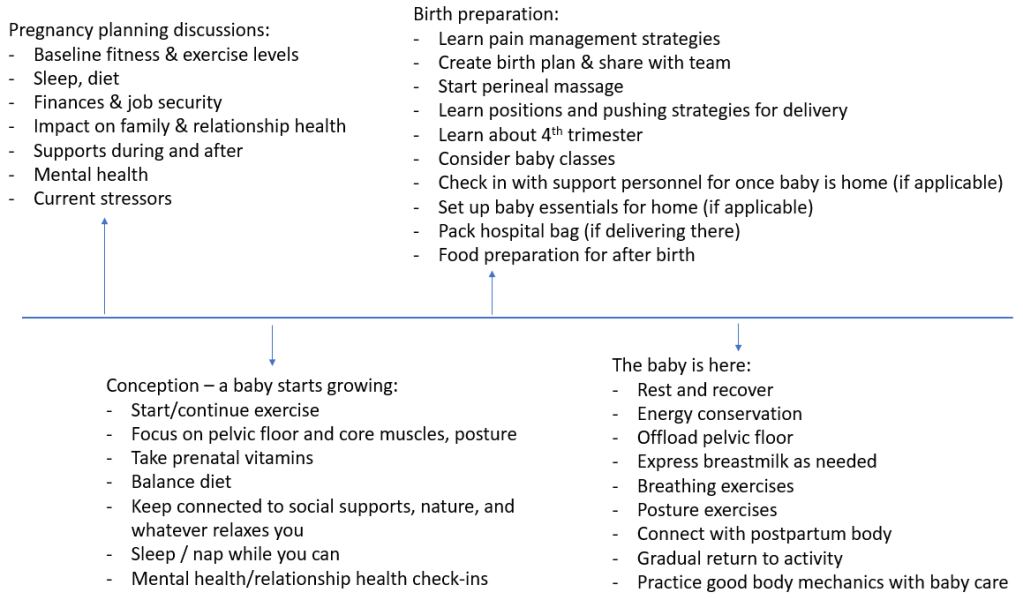
Just like a marathon, recovery after the event is also important. Your body just went through a lot of stress. It’s time to de-load. The first few weeks should prioritize rest, recovery and sleep as much as possible. Give your pelvic floor a break and kick your feet up. Express breastmilk for comfort (and to feed the baby, if applicable). Work on breathing exercises and reconnect with your body. Slowly start increasing movement, and over the next few months you’ll see how far you’ve come in the recovery process!
 Against All Pains