Sleep has an influence on managing pain since sleep and pain share the same pathways and neurotransmitters! It is not just the length of sleep that matters, but the quality of sleep as well.
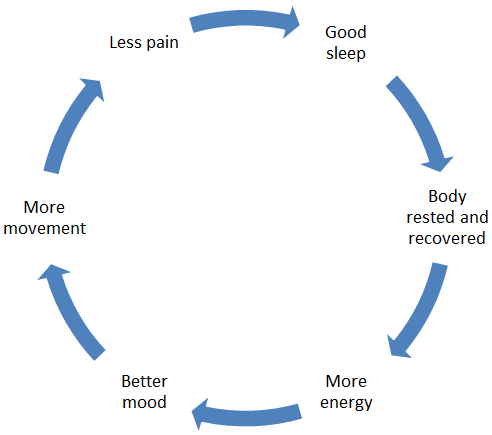
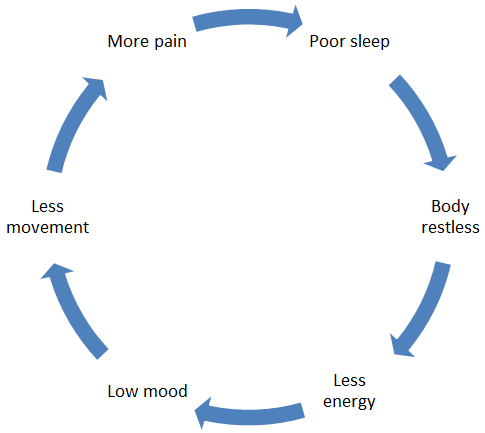
Sleep hygiene has been shown to help improve sleep. Some recommendations include:
- Having a bedtime ritual or routine to stick to
- Setting a bedtime and waking time and keeping it consistent
- Making the bedroom environment comfortable – cooler temperature, low lighting (consider black out blinds)
- Using the bedroom only for sleep and sex – the brain will start making the association of the environment to activity
- No clock watching – even if you can’t sleep, don’t check how much time you have lost, or still have before wake up time
- Keep a pen and paper nearby so you can empty the mind if something pops up or persists while trying to sleep
- Keep off devices and screens 1-2 hours before bedtime
- Cut off eating and drinking 2 hours before bed
- Doing something to relax and unwind before bed, such as reading a book, praying, listening to soothing sounds, journaling, meditating
- Physical exhaustion helps improve sleep – consider exercising regularly
If performing good sleep hygiene doesn’t seem to help your sleep as much as you would like, another strategy to consider is sleep compression therapy. In this approach, the goal is to maximize sleep efficiency. The actual time asleep in bed should be at least 80% of the time spent in bed. This will help improve sleep quality. Then, we slowly increase time in bed to increase sleep quantity.
Sleep Efficiency = (time asleep ÷ time in bed) x 100
Examples:
John went to bed at 11PM and got out of bed at 8AM *Time in bed = 9 hours
John slept for 5 of those hours and was awake/restless the rest of the time
John’s sleep efficiency = (5 hours ÷ 9 hours) x 100 = 55.6%


Jane went to bed at 10PM and got out of bed at 6AM *Time in bed = 8 hours
Jane slept for 7 of those hours and was awake/restless the rest of the time
Jane’s sleep efficiency = (7 hours ÷ 8 hours)x 100 = 87.5%
SLEEP EFFICIENCY GOAL of 80%
To apply sleep compression therapy, first keep a sleep diary for a week. Track when you go to bed and when you wake up, and estimate how many hours you slept each night. Then, average the sleep time. The following week, spend only that amount of time in bed each night, and try to have a set time to go to bed and to get up from bed. Monitor how many hours you slept each night. If your sleep efficiency is 80% or more, start increasing the amount of time in bed by 15-30 minutes, and continue with this pattern as long as you still hit that 80% goal. If you fall short of it, stick to the same amount of time in bed until your time asleep improves. Continue using this strategy until you’ve hit your target sleep quantity, and the result should be improved sleep quality and quantity!
With sleep compression therapy, it is important to avoid sleep even if you are tired, if it is outside your scheduled sleep time. Avoid napping as well. There may be sleep deprivation to start, so keep that in mind when you’re doing activity during the day, such as operating a vehicle or machinery where you may be in danger.
Other Resources
- Sleep duration and affective reactivity to stressors and positive events in daily life (2020) https://psycnet.apa.org/record/2020-66624-001
- Sleep and stress article https://greatergood.berkeley.edu/article/item/your_sleep_tonight_changes_how_you_react_to_stress_tomorrow?utm_source=Greater+Good+Science+Center&utm_campaign=5f6768e6cd-EMAIL_CAMPAIGN_GG_Newsletter_December_17&utm_medium=email&utm_term=0_5ae73e326e-5f6768e6cd-74369575
- 10-Minute Meditation for Sleep – https://www.youtube.com/watch?v=aEqlQvczMJQ
 Against All Pains